

Use our free Sum of GP Calculator to find the sum of the first n terms of an infinite geometric progression. It will provide step-by-step results; the formula of the GP sum and a graph are included. The graph feature is the most special thing about this calculator; not any other GP calculator can provide this feature. So check this out and provide us your feedback after using it.
—
—
Sum of GP Calculator – Easy Calculator to Find Geometric Progression Sums
Looking for a quick and easy way to calculate the sum of geometric progression? Whether you are doing math homework, planning your finances, or just learning for yourself, our Sum of GP Calculator makes it easy. You can quickly find the sum of the first n terms or the infinite sum if the common ratio allows. On top of that, it shows step-by-step calculations, the formula used, and even a graph of partial sums so you can clearly see how the total adds up.
What is a Geometric Progression (GP)?
A geometric progression (GP) is a series of numbers where each number is found by multiplying the one before it by the same value, which we call the common ratio (r).
For example, take this sequence:
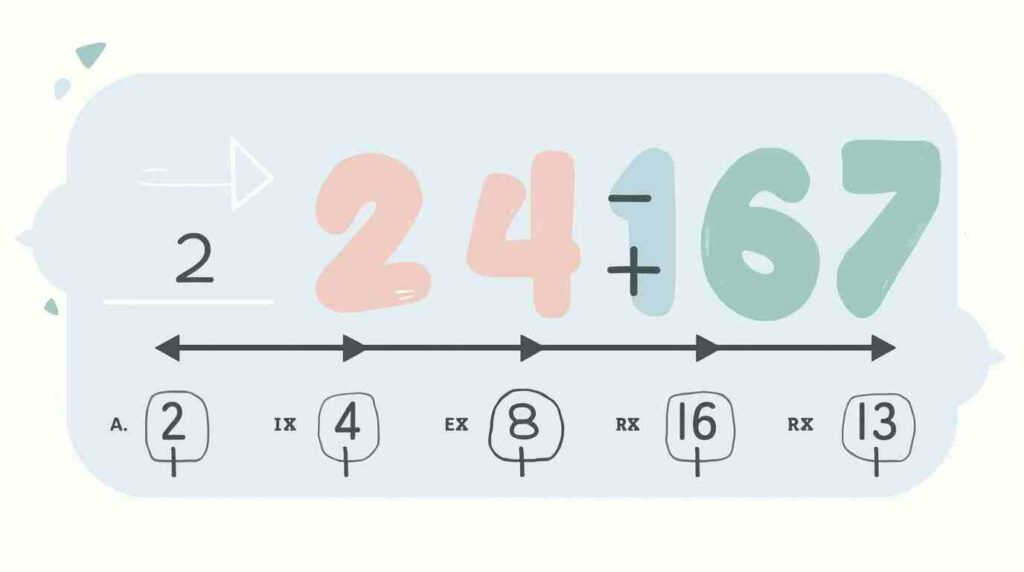
2, 4, 8, 16, 32, ...
Here, the first number is a = 2, and the common ratio is r = 2, because each number is twice the one before it.
Geometric progressions are used in many real-life situations, like saving money with interest, population growth, physics problems, and computer calculations. Learning to calculate the sum of gp calculator can be very helpful in these fields.
Sum of a GP—Formula and Concept
The sum of a geometric progression depends on whether you have a finite number of terms or an infinite series.
1. Finite GP Sum (n terms)
If you know the first term (a), the common ratio (r), and the number of terms (n), the sum of the first n terms is calculated using the formula:
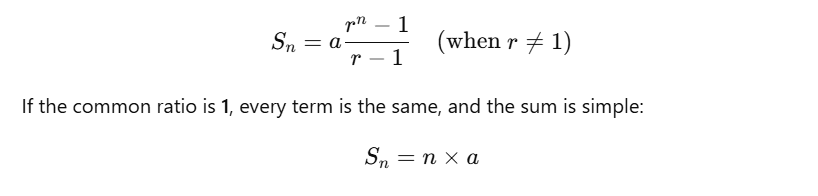
Example:
- First term a=3
- Common ratio r=2
- Number of terms n=5

So, the sum of the first 5 terms is 93.
2. Infinite GP Sum
If the number of terms goes to infinity, the series is called an infinite GP. An infinite GP has a sum only if the absolute value of the common ratio is less than 1

The formula for the infinite sum is

Example:
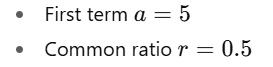

So, the infinite sum is 10.
How to Use This Sum of GP Calculator?

Our calculator is very easy to use and interactive. Just follow these simple steps:
- Enter the first term (a): This is the starting number of your sequence.
- Enter the common ratio (r): This is the number that each term is multiplied by to get the next term.
- Enter the number of terms (n): if you want a finite sum.
- Or check “Compute infinite sum” if you want the infinite sum (only works if , i.e., ∣r∣<1)
- Click Calculate: You will see the sum, the formula used, a step-by-step explanation, and a graph showing partial sums for better understanding.
Additional features:
- Copy Result: Quickly copy your result, formula, and steps.
- Export CSV: Download your calculation for future reference.
- Share Result: Easily share your GP sum on social media or with friends.
Why Is This Calculator Useful?
Using the right tool can make calculating the sum of a geometric progression much easier. Here’s why this online geometric progression calculator is helpful:
- Saves time: You don’t have to calculate manually or worry about mistakes in long series.
- Step-by-step explanation: See exactly how the sum is calculated and learn the process clearly.
- Visual graph: Watch how the partial sums grow term by term, making it easier to understand.
- Supports infinite GP: Can handle series that go on forever, as long as the common ratio allows.
- Mobile-friendly: Works smoothly on smartphones, tablets, and desktops, so you can use it anywhere.
Examples You Can Try
Example 1 – Finite GP

Example 2 – Finite GP with negative r

Example 3 – Infinite GP

Tips for Using the Calculator
Using the calculator is very simple, but keeping a few points in your mind will help you to get accurate results each and every time:
- Enter a positive number for n: For finite sums, n must always be a positive whole number.
- Check the common ratio for infinite sums: The infinite sum only exists if the absolute value of r is less than 1 (∣𝑟∣<1).
- Fractions and decimals are allowed: You can enter values like 1/2, 0.25, or other decimal numbers for a and r.
- Special case when r = 1: If the common ratio is 1, the sum is simply the first term multiplied by the number of terms.
By following these simple tips, you can use our Sum of GP calculator easily and confidently for any geometric progression series.
Frequently Asked Questions (FAQs)
Can I use a negative ratio?
Yes! Negative ratios are allowed and will alternate the signs of terms in the series.
What happens if r = 1?
If r = 1, the sum is simply the first term multiplied by the number of terms (Sₙ = n × a).
Can I calculate very large n?
Yes, but for very large n, the graph may not display all points clearly. This geometric progression calculator handles sums up to n = 50 in the graph for clarity.
Can I save my result?
Yes! You can copy, export CSV, or share the result directly from this online Sum of GP calculator.
Conclusion
Our sum of GP calculator is a simple and powerful calculator for students, teachers, and anyone who is involved with numbers. Whether you’re solving math problems, checking financial growth, or learning about geometric sequences, this geometric progression calculator makes the process quick and accurate for everyone.
Special feature: It not only gives you the answer but also shows the formula, step-by-step calculations, and a visual graph to help you understand how the sum is calculated.
Try it out and see how easy it is to find the sum of any geometric sequence in just a few seconds!
Visit calculatorlogic.com to check more calculators.
Enjoyed this calculator? Share it now



